The 300-Year-Old Law on Prostitutes Still Written on a Wall in Florence

One of the things I love most about Florence is that history is not confined to museums. Sometimes it is right there on the wall of a building, waiting for someone to stop and wonder what it says.
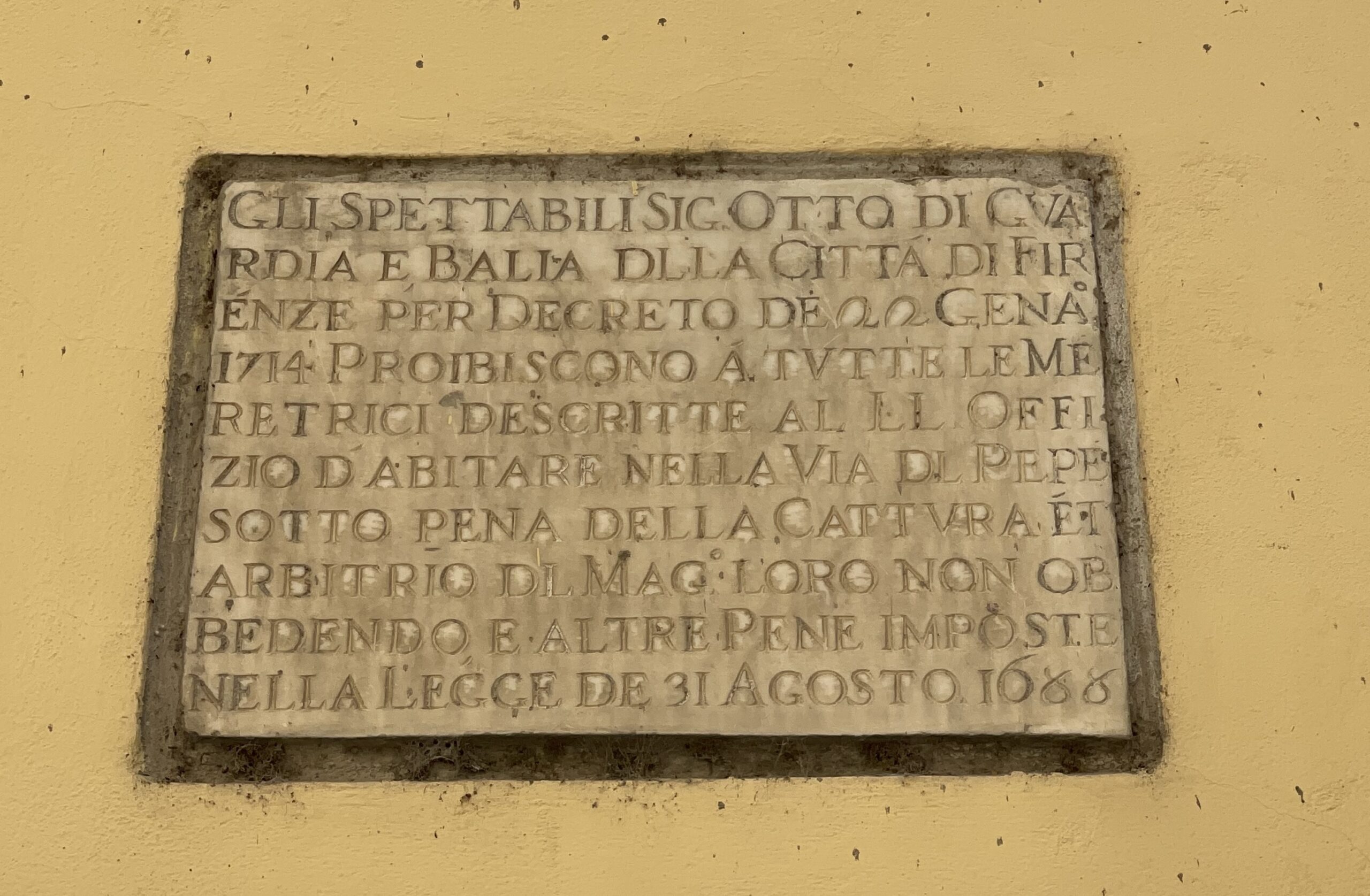
While walking near Piazza Santa Croce, I noticed an old stone plaque mounted on a wall. The Italian was archaic and filled with abbreviations, but one word immediately caught my attention:
MERETRICI (which means “prostitutes”)…
Naturally, I wanted to know the rest of the story. What Does the Plaque Say?
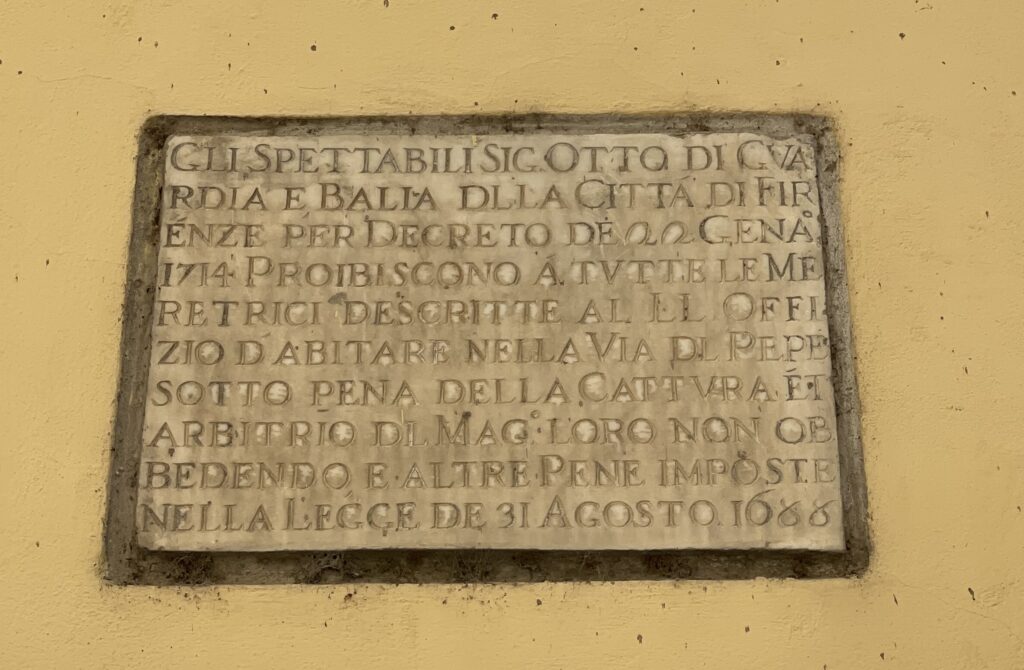
The plaque records a decree issued in 1714 by a powerful Florentine magistracy known as the Otto di Guardia e Balìa, or the Eight of Guard and Balia.
The inscription reads, with the abbreviations expanded:
“Gli Spettabili Signori Otto di Guardia e Balìa della Città di Firenze, per decreto de’ 22 gennaio 1714, proibiscono a tutte le meretrici descritte al loro uffizio d’abitare nella Via di Pepe, sotto pena della cattura et arbitrio delle Magnificenze Loro, non obbedendo, e altre pene imposte nella legge de’ 31 agosto 1688.”
In modern English, the meaning is approximately:
“The Honorable Eight of Guard and Balia of the City of Florence, by decree of January 22, 1714, prohibit all prostitutes registered with their office from residing in Via di Pepe. Those who disobey are subject to arrest, punishment at the discretion of the magistrates, and the additional penalties imposed by the law of August 31, 1688.”
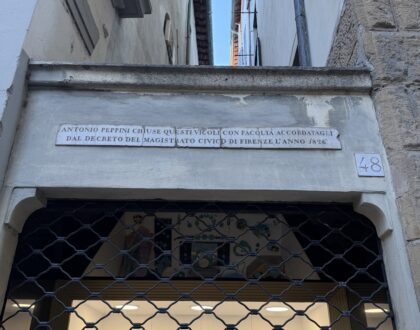
The street identified on the plaque as Via di Pepe is associated with the area now known as Via del Fico, in the Santa Croce neighborhood. Historical descriptions of the street explain that the narrow lanes in this part of Florence had been frequented and inhabited by prostitutes, and that in 1714 local residents and nearby religious institutions succeeded in obtaining a decree restricting their presence.
In other words, the stone plaque is a 300-year-old public notice enforcing a local law. And it is still hanging there.
Who Were the Otto di Guardia e Balìa?
The name sounds like a person, but it was actually an institution.
The Otto di Guardia e Balìa were a board of eight Florentine officials responsible for public security, policing, criminal investigation, and, over time, much of the administration of criminal justice.
The institution was created in the aftermath of the 1378 Ciompi Revolt, one of the great social upheavals of medieval Florence. Originally established as an extraordinary public-security body, it became a permanent institution of the Florentine Republic in 1380. Over the centuries, its powers expanded significantly.
The Eight were supported by officers, guards, messengers and other personnel. The historical record indicates that their activities included pursuing criminals, investigating suspected rebellion, gathering intelligence and coordinating security throughout Florentine territory. By the early 16th century, the institution had acquired an enormously important role in Florence’s criminal justice system.
The institution survived the transition from the Florentine Republic to Medici rule and continued operating until 1777, when judicial reforms under Grand Duke Pietro Leopoldo abolished it and transferred its functions to a new supreme court of justice.
The City of Florence’s own historical materials describe the soldiers serving the Eight as a type of police force charged with maintaining public safety and order.
Florence’s Laws Were Written on Its Walls
What makes this story especially fascinating is that this plaque is not unique.
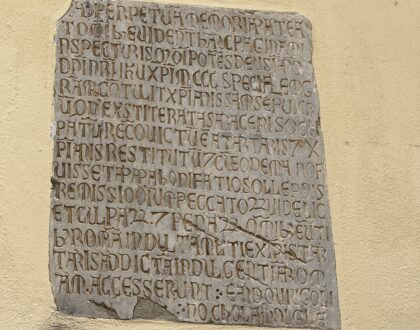
Throughout Florence and other parts of Tuscany, stone inscriptions issued under the authority of the Otto di Guardia e Balìa can still be found on buildings. They regulated everyday urban behavior: gambling, noisy games, singing, dumping rubbish, urinating in public places, selling goods in prohibited areas, keeping animals, and prostitution.
One research project devoted to these inscriptions reports identifying more than 100 surviving examples in and around Florence, with the greatest concentration in the historic center.
These plaques were, in a sense, the municipal notices of their time.
There was no neighborhood Facebook group. No city website. No email notification from the municipality.
The law was carved into stone and placed directly where the prohibited activity was taking place.
A Glimpse Into Everyday Florence
When we think about historic Florence, we naturally think about Michelangelo, Leonardo da Vinci, the Medici family, magnificent churches, palaces and Renaissance art.
But plaques like this tell us about another Florence.
The Florence of ordinary streets.
The Florence of neighbors complaining about noise.
The Florence of city officials trying to control crime and public behavior.
The Florence of businesses, taverns, gambling, prostitution and disputes over what was (and was not) acceptable in a particular neighborhood.
That is what I find so interesting about this plaque. It is not about a king, a famous artist or a great battle. It is about everyday life in Florence more than 300 years ago.
And as a lawyer, I find another aspect particularly interesting: this was law communicated directly through the built environment. A decree was issued, enforcement authority existed behind it, and the rule was physically posted in permanent form at the place where it applied.
More than three centuries later, the people who issued the decree are gone. The legal system that enforced it is gone. The street itself has changed.
But the notice remains.
That is one of the reasons I never get tired of walking through Florence.
The city is always telling you a story. Sometimes you just have to look up and read the walls.