The Sealed Streets of Florence: The Story Behind a Mysterious 200-Year-Old Plaque

One of the things I love most about Florence is that you can walk down the same street a hundred times and still discover something new.
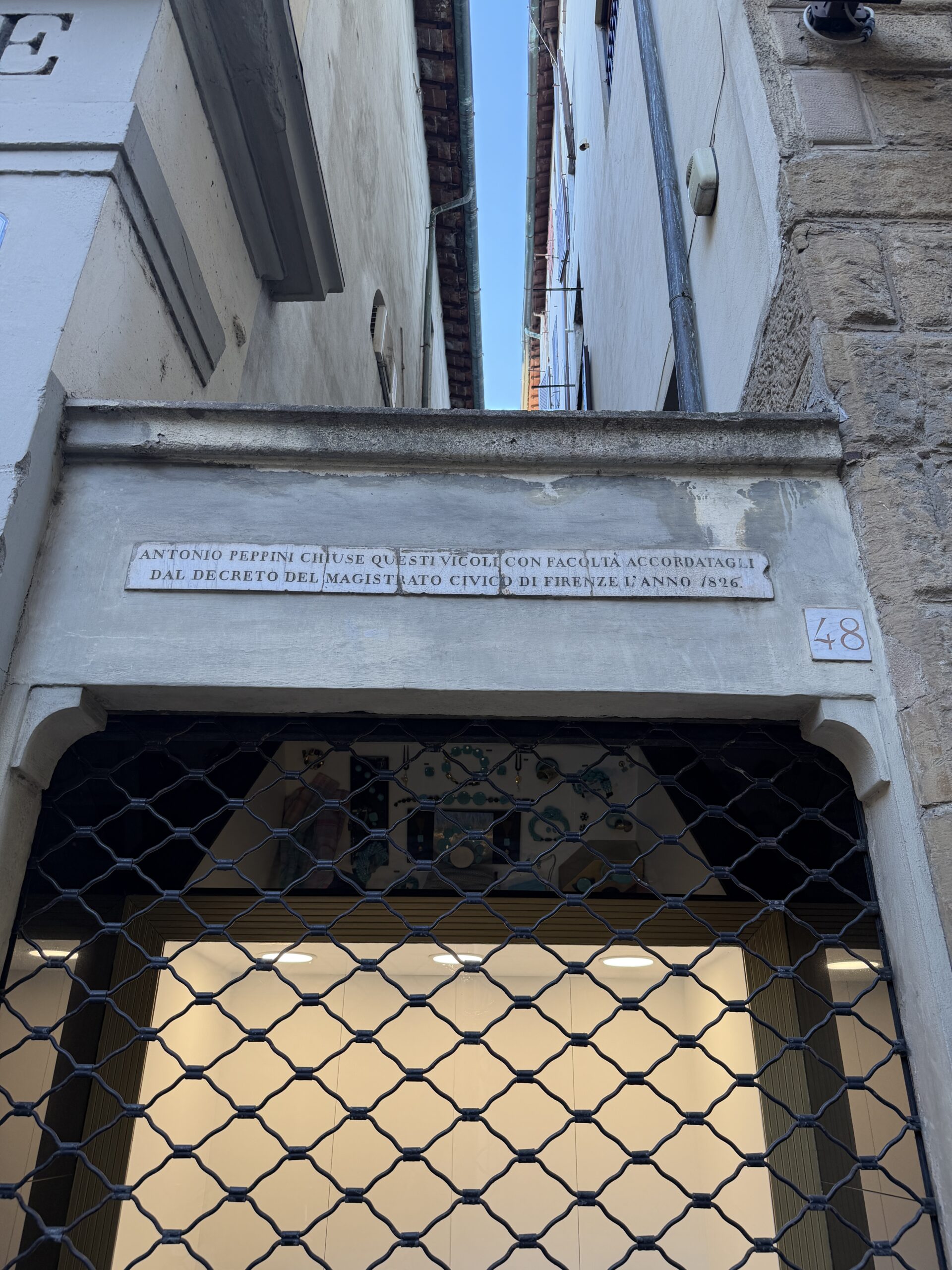
Recently, while walking through the historic center, I noticed something unusual: what appeared to be an old passageway that had been completely sealed. Above it was a stone plaque bearing the following inscription:
“Antonio Peppini chiuse questi vicoli con facoltà accordatagli dal decreto del Magistrato Civico di Firenze l’anno 1826.”
In English this means: “Antonio Peppini closed these alleys with authority granted to him by decree of the Civic Magistrate of Florence in the year 1826.”
I immediately wanted to know the story.
Why had one man been given permission to close entire alleys in the center of Florence? And why, almost 200 years later, was the city still telling us about it?
THE FORGOTTEN BATHS OF FLORENCE
The answer leads to a largely forgotten chapter of Florentine history.
In the area near Borgo Santi Apostoli and Piazza del Limbo once stood the Bagni Peppini, also known as the Bagni delle Antiche Terme (the Baths of the Ancient Thermal Baths). Historical accounts place Antonio Peppini’s public bathing establishment in an area associated with the ancient Roman baths of Florentia.
In 1826, Peppini received official authorization from Florence’s civic authorities to close the small alleys adjacent to his establishment. The plaque was placed there to record that the closure was not simply the act of a private property owner taking over public space: it had been formally authorized by the city. And there it remains today, a nearly 200-year-old public notice written in stone.
FLORENCE BEFORE MODERN PLUMBING
It is easy to forget that the Florence we experience today was once a very different city.
In the early 19th century, private bathrooms and modern plumbing were not part of everyday life. Public bathing establishments served an important practical purpose, but some also offered a more refined experience connected with wellness and therapeutic treatments.
The Bagni Peppini belonged to this world. The establishment was built in 1826 and remained active until the early 20th century. Historical descriptions of the area identify it as a public bathing facility situated where tradition and local history associated the site with much older Roman thermal baths.
Today, the baths are gone, the passages are closed, and most people walking nearby probably have no idea what once existed behind those walls.
But the plaque remains.
A LEGAL DOCUMENT CARVED IN STONE
As a lawyer, this may be the part of the story that fascinates me the most.
Today, a municipal decision allowing a private individual to close or alter a public passage would exist in ordinances, resolutions, permits, property records, surveys, and digital databases.
In 1826 Florence, the authority was announced directly on the building.
The inscription essentially says: Yes, these streets were closed. Yes, Antonio Peppini did it. And yes, the City of Florence gave him permission.
Almost two centuries later, the notice is still doing its job.
THIS IS WHY I LOVE FLORENCE
There are cities where history is something you visit inside a museum. Florence is different. History is built into the walls. It is written above doorways. It appears on the corners of buildings and in small passages that seem to lead nowhere. Sometimes an old stone plaque can tell the story of a forgotten business, a municipal decree, a changing city, and a man named Antonio Peppini who received permission to close a few Florentine alleys in 1826.
The next time you walk through Florence, look up. The city is always telling you something.