The Florentine Couple Who Went to Rome in 1300 and Carved the Story Into Their House

One of the reasons I love walking through Florence is that you never know what story is hiding on the wall in front of you.
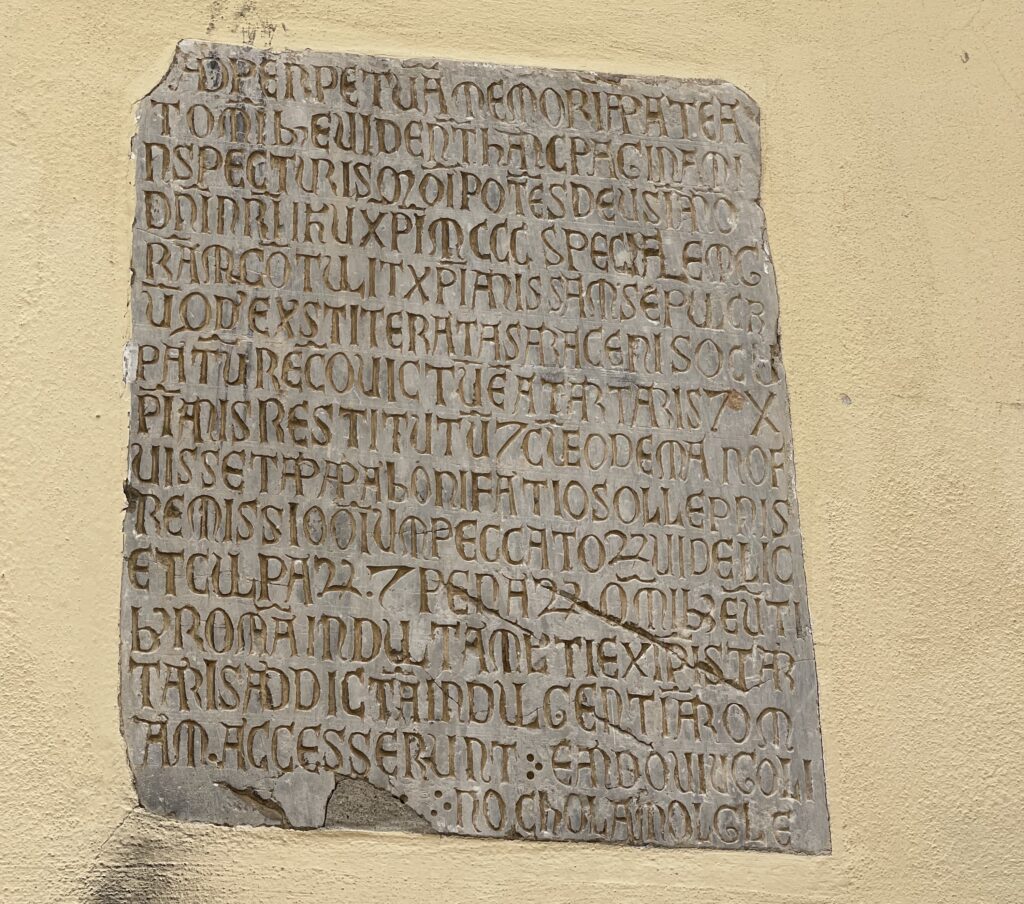
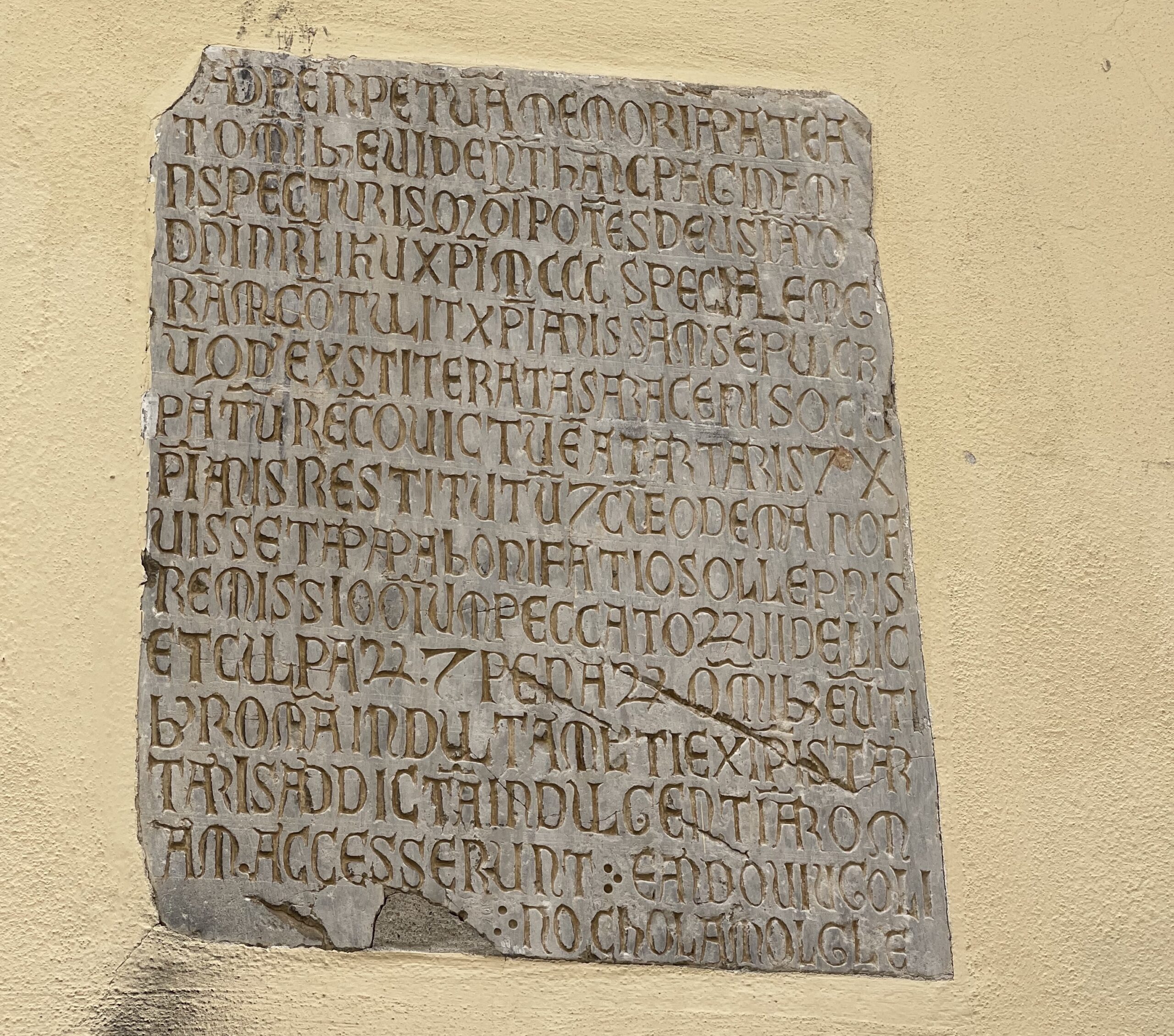
Recently, while walking along Via Giovanni da Verrazzano, near Santa Croce, I noticed an old stone inscription built into the wall of an otherwise modest house.
At first glance, it is difficult to understand. The inscription is written primarily in medieval Latin, the words are heavily abbreviated, and the stone has suffered centuries of wear.
But the story behind it is remarkable.
It tells us about a Florentine man named Ugolino, his wife, and a journey they made to Rome more than 700 years ago.
The First Jubilee of 1300
In 1300, Pope Boniface VIII proclaimed what became recognized as the first Christian Jubilee, offering a plenary indulgence under prescribed religious conditions to pilgrims who traveled to Rome and visited the designated basilicas.
The event drew extraordinary numbers of pilgrims from across Europe. Contemporary and later accounts describe enormous crowds traveling to and from Rome, and the Via Giovanni da Verrazzano inscription is rare physical evidence of how that great movement of pilgrims reached the lives of ordinary Florentines.
Among those pilgrims were Ugolino and his wife. And apparently, Ugolino wanted people to remember it.
What Does the Plaque Say?
The inscription begins formally:
“Ad perpetuam memoriam…”
Or:
“For perpetual memory…”
It goes on to announce to future readers that in the year 1300, God had granted a special grace to Christians. The inscription then refers to the Holy Sepulchre, the Saracens and Tartars, and the solemn remission of sins proclaimed by Pope Boniface VIII for those traveling to Rome.
The inscription is grand, solemn and religious. And then something wonderful happens. After all that formal medieval Latin, the inscription suddenly ends in the everyday Florentine vernacular: “E andovi Ugolino chola molgle.”
In modern Italian:
“E ci andò Ugolino con la moglie.”
And in English:
“And Ugolino went there with his wife.”
Scholarly discussion of the inscription specifically notes this striking switch from formal Latin to the vernacular when the inscription reaches the personal fact Ugolino most wanted remembered: that he and his wife made the pilgrimage.
I love that.
More than seven centuries later, we do not know much about Ugolino. We do not know what he and his wife talked about on the road, what hardships they encountered, where they slept, or what they thought when they finally arrived in Rome.
But we know they went. Because Ugolino made sure to tell us.
What Would the Journey Have Been Like?
Today, a journey from Florence to Rome can be accomplished by high-speed train in a matter of hours. In 1300, it was an entirely different undertaking.
The journey would have been made on foot or, for those with the means, partly on horseback or with animals and carts. Pilgrims traveled along networks of roads and pilgrimage routes, staying at religious houses, hospitals, inns and other places of shelter.
The road could be physically exhausting and dangerous. Travelers faced weather, illness, poor roads, theft and the ordinary uncertainties of medieval travel.
Yet Ugolino and his wife joined the great movement toward Rome.
The plaque remains on the façade of the house associated with Ugolino and is recognized as a memorial to their journey for the Jubilee of 1300.
A Medieval Facebook Post?
I cannot help but think of this plaque as a 700-year-old version of something we still do today.
We travel somewhere extraordinary. We take photographs. We write about the experience. We post it online because we want our friends, and perhaps people we will never meet, to know that we were there.
Ugolino did not have Facebook or Instagram. He had stone. And he used it to tell future generations: My wife and I went to Rome. We were there. We were part of this historic moment.
Seven hundred years later, someone walking through Florence can still stop, look up, and read his message.
The Walls of Florence Are Still Talking
When most people think of Florence, they think of the great names: Michelangelo, Leonardo da Vinci, Dante Alighieri, and the Medici.
But I am increasingly fascinated by the people whose names are not in the history books. People like Ugolino and his wife. They lived in Florence. They made a difficult journey to Rome during one of the most extraordinary religious events of the Middle Ages. Then they came home and left a message on the wall. More than 700 years later, that message is still there.
E andovi Ugolino chola molgle. And Ugolino went there with his wife.
Sometimes the smallest stories are the ones that make history feel most human.